Om Shri GuruBhyo Namah. Jai Khyapa Parampara.
Thank you, Ma Adya, for permitting me to write this. You have sent me here again with amnesia. Please forgive the mistakes I have made, or may still make. You are trikaldarshi; nothing is hidden from you. Please grant me the strength to sing your glory again with the tools of this age.
Prayer from your eternal dasa, sevak, and putra, Ashish.
Jai Ma Adya Mahakali, Jai Ma Krishna, Jai Kalabhairava
This article is a simple guide to the Shri Kali Tandava Stotram: the English recitation, a plain translation, and a verse-by-verse commentary for seekers who feel drawn toward Ma Kali.
Introduction to the Shri Kali Tandava Stotram
The word Tāṇḍava refers to a fierce, divine dance. It is usually associated with Shiva in his Nataraja form, the dance through which creation, preservation, and dissolution move in rhythm. In this stotram, that same force is seen through Ma Kāli, the primordial Shakti.
The hymn presents Ma Kāli in a way that can unsettle the ordinary mind. Her imagery is intense, uncompromising, and impossible to reduce to something merely decorative. Yet for the bhakta, that same form is liberating. She is time, power, reality, change, and the force that strips away illusion.
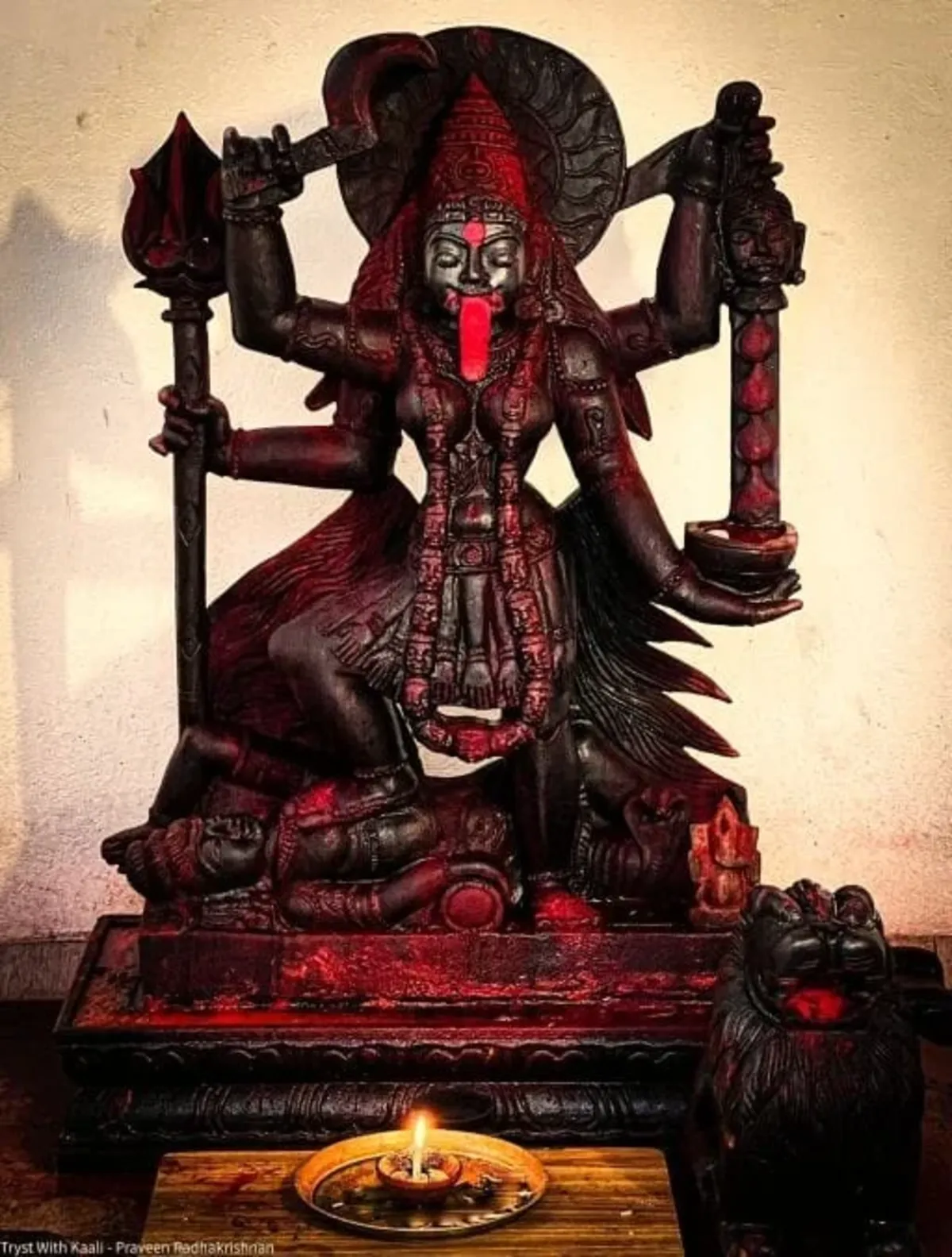 Ma Kali in her fierce Tandava form - the Divine Mother as the all-consuming power of transformation.
What I find powerful about this stotram is that it never separates her terrifying form from her motherly nature. The same Ma who shocks the ego is the one who protects the seeker. That is why the old images still carry force, and why even modern renderings can still serve as reminders when approached with bhava instead of spectacle.
English Recitation Guide
huṃhuṃkāre śavārūḍhe nīlanīrajalocane ।
trailokyaikamukhe divye kālikāyai namo'stute ॥1॥
pratyālīḍhapade ghore muṇḍamālāpralambite ।
kharve lambodare bhīme kālikāyai namo'stute ॥2॥
navayauvanasampanne gajakumbhopamastanī ।
vāgīśvarī śive śānte kālikāyai namo'stute ॥3॥
lolajihve durārohe netratrayavibhūṣite ।
ghorahāsyatkare devī kālikāyai namo'stute ॥4॥
vyāghracarmmāmbaradhare khaḍgakarttṛkare dhare ।
kapālendīvare vāme kālikāyai namo'stute ॥5॥
nīlotpalajaṭābhāre sindurendumukhodare ।
sphuradvaktroṣṭadaśane kālikāyai namo'stute ॥6॥
pralayānaladhūmrābhe candrasūryāgnilocane ।
śailavāse śubhe mātaḥ kālikāyai namo'stute ॥7॥
brahmaśambhujalaughe ca śavamadhye prasaṃsthite ।
pretakoṭisamāyukte kālikāyai namo'stute ॥8॥
kṛpāmayi hare mātaḥ sarvāśāparipūrite ।
varade bhogade mokṣe kālikāyai namo'stute ॥9॥
ityuttaratantrārgatamaṃ śrīkālītāṇḍavastotraṃ sampūrṇam
Verse 1
huṃhuṃkāre śavārūḍhe nīlanīrajalocane ।
trailokyaikamukhe divye kālikāyai namo'stute ॥1॥
Translation
To Her who resounds with the primordial sound "Huṃ," who is mounted upon a lifeless form (śava), whose eyes are like blue lotuses; to that divine Goddess who is the one face of the three worlds, to You, Kālikā, I offer my salutations.Commentary
The opening verse immediately places Ma Kāli beyond ordinary categories.huṃhuṃkāre: "Huṃ" is a fierce bīja mantra. It carries the sense of concentrated divine power, protection, and awakened consciousness. Her very presence is described as vibrating with that force.
śavārūḍhe: She is seated upon a corpse. In traditional symbolism, this shows Shakti as the animating force of existence. Without her movement, the universe is inert. The image also reminds the seeker that she is beyond bodily identity and beyond death.
nīlanīrajalocane: Her blue-lotus eyes temper the fierceness of the verse. They suggest depth, stillness, beauty, and mystery. The hymn is already telling us that her terrible form and her compassionate form are not separate.
trailokyaikamukhe: She is the one reality behind all three worlds. What appears divided across planes of existence is still held in a single divine face.
Verse 2
pratyālīḍhapade ghore muṇḍamālāpralambite ।
kharve lambodare bhīme kālikāyai namo'stute ॥2॥
Translation
To Her who stands in the Pratyālīḍha warrior pose, who is fearsome, and adorned with a long, dangling garland of severed heads; to Her who is short in stature, with a large belly, and who is terrifying to behold, to You, Kālikā, I offer my salutations.Commentary
This verse brings out her warrior form with full force.pratyālīḍhapade: This is a martial stance. She is not passive here. She is shown in action, confronting ignorance, inertia, and ego. Her path is not sentimental. She meets the seeker in the inner battlefield.
ghore muṇḍamālāpralambite: Her garland of severed heads is not random violence. It represents the cutting away of false identities, pride, and limited selfhood. Her fierceness is purposeful. It destroys what binds.
kharve lambodare bhīme: Her shortness can be read as concentrated power. Her large belly suggests the capacity to contain worlds within herself. She is terrible to the ego, but motherly to the bhakta.
Verse 3
navayauvanasampanne gajakumbhopamastanī ।
vāgīśvarī śive śānte kālikāyai namo'stute ॥3॥
Translation
To Her who is endowed with the fullness of eternal youth, whose breasts are full and majestic like the frontal globes of an elephant's head; to the supreme Goddess of Speech, the auspicious and peaceful one, to You, Kālikā, I offer my salutations.Commentary
After the frightening imagery of the previous verse, this one reveals a very different register.navayauvanasampanne: She is ever-youthful. The point is not age in a worldly sense, but inexhaustible vitality. She is the fresh and unspent energy behind creation itself.
gajakumbhopamastanī: This classical metaphor speaks of abundance, nourishment, majesty, and strength. As Mother, she feeds both worldly life and spiritual life.
vāgīśvarī śive śānte: She is the source of speech, wisdom, auspiciousness, and peace. That contrast matters. The same goddess who terrifies the ego is also the one who grants clarity, steadiness, and inward quiet.
Verse 4
lolajihve durārohe netratrayavibhūṣite ।
ghorahāsyatkare devī kālikāyai namo'stute ॥4॥
Translation
To Her with the lolling, restless tongue, who is difficult to approach or comprehend, and who is adorned with three eyes; to the Goddess whose terrifying laughter resounds, to You, Kālikā, I offer my salutations.Commentary
Here the stotram turns toward her mystery and her world-shaking force.lolajihve: Her extended tongue represents unrestrained power, the consuming force of dissolution, and the intensity with which she absorbs all that must return to her.
durārohe: She cannot be grasped by ordinary intellect. There is a reason Kali sadhana is not approached casually. Her reality asks for courage, sincerity, and the willingness to lose what is false.
netratrayavibhūṣite: Her three eyes are the sun, moon, and fire. They also point to her vision across past, present, and future. She is trikaldarshi, and the seeker stands fully exposed before that gaze.
ghorahāsyatkare: Her fierce laughter shatters illusion. It is the laughter of a freedom so absolute that the structures built by fear cannot survive it.
Verse 5
vyāghracarmmāmbaradhare khaḍgakarttṛkare dhare ।
kapālendīvare vāme kālikāyai namo'stute ॥5॥
Translation
To Her who wears a tiger skin as her garment, who holds a sword and a cleaver in her hands; and who in her left hands holds a skull-cup and a blue lotus, to You, Kālikā, I offer my salutations.Commentary
This verse is rich in symbolic detail. It is less about a fixed iconographic checklist and more about the powers gathered in her hands.vyāghracarmmāmbaradhare: The tiger skin suggests mastery over raw instinct, ferocity, and animal nature. She is not overpowered by primal force; she wears it.
khaḍgakarttṛkare: The sword cuts ignorance, doubt, and bondage. The cleaver severs attachment, especially attachment to the ego and its story.
kapālendīvare vāme: The skull-cup points to detachment from bodily identity and to the acceptance of impermanence. The blue lotus stands beside that imagery as a reminder that grace, knowledge, and beauty can still arise from what looks dark or ruined.
Verse 6
nīlotpalajaṭābhāre sindurendumukhodare ।
sphuradvaktroṣṭadaśane kālikāyai namo'stute ॥6॥
Translation
To Her whose mass of matted hair is dark like a blue lotus, whose face shines with sindoor and the moon; whose face, lips, and teeth are radiant and vibrant, to You, Kālikā, I offer my salutations.Commentary
This verse lingers on her face, and in doing so makes her presence feel more intimate.nīlotpalajaṭābhāre: Her matted hair marks her as untamed, free, and beyond convention. Its dark hue suggests depth and infinity rather than mere ornamentation.
sindurendumukhodare: The sindoor and the moon place her in relation to Shiva while also showing beauty within austerity. Ferocity is present, but so is luminosity.
sphuradvaktroṣṭadaśane: Her features are alive with force. Nothing about her is static. Even her teeth and lips are described as vibrant, as if the hymn wants us to feel that her power is always in motion.
Verse 7
pralayānaladhūmrābhe candrasūryāgnilocane ।
śailavāse śubhe mātaḥ kālikāyai namo'stute ॥7॥
Translation
To Her whose complexion is like the smoke of the great fire of universal dissolution, whose three eyes are the moon, sun, and fire; O auspicious Mother who resides in the mountains, to You, Kālikā, I offer my salutations.Commentary
This is one of the most cosmic verses in the stotram.pralayānaladhūmrābhe: Her complexion is compared to the smoke of final dissolution. This is not just darkness in a visual sense. It is the afterglow of total ending, the reminder that all manifested things return.
candrasūryāgnilocane: Her eyes are the moon, the sun, and fire: cooling consciousness, sustaining life, and transforming force. The universe's major lights are gathered in her gaze.
śailavāse śubhe mātaḥ: The verse then softens. After describing her at the scale of cosmic dissolution, it addresses her simply as auspicious Mother. That shift is beautiful. The infinite power remains, but devotion steps forward without fear.
Verse 8
brahmaśambhujalaughe ca śavamadhye prasaṃsthite ।
pretakoṭisamāyukte kālikāyai namo'stute ॥8॥
Translation
To Her who, in the great deluge of dissolution where even Brahma and Shambhu (Shiva) dissolve, is found established amidst the corpses; to Her who is accompanied by trillions of spirits, to You, Kālikā, I offer my salutations.Commentary
This verse places Ma Kāli at the very ground of reality.brahmaśambhujalaughe: Even the great gods return into the causal flood at the end of a cosmic cycle. She is praised here as prior to that process and beyond it.
śavamadhye prasaṃsthite: She remains established in the stillness that follows total dissolution. When names, forms, and movements fall away, she is still there.
pretakoṭisamāyukte: The spirits around her indicate command over the unseen and over the liminal zones most people fear. This is one reason Bhairava and guru tattva are so often remembered in relation to her worship. The path needs steadiness, guidance, and protection.
Verse 9
kṛpāmayi hare mātaḥ sarvāśāparipūrite ।
varade bhogade mokṣe kālikāyai namo'stute ॥9॥
Translation
O Mother who is full of mercy, the remover of all suffering, the one who completely fulfills all hopes and desires; the giver of boons, the bestower of worldly enjoyments, and the granter of final liberation (Moksha), to You, Kālikā, I offer my salutations.Commentary
The final verse gathers the whole stotram into one direct gesture of surrender.kṛpāmayi hare mātaḥ: After all the fearsome imagery, she is addressed here first as merciful Mother. That is not a contradiction. It is the truth the stotram has been building toward from the start.
sarvāśāparipūrite: She fulfills longing at every level, from worldly need to the seeker's highest aspiration.
varade bhogade mokṣe: She grants boons, allows worldly experience, and also gives moksha. The hymn does not split life into artificial categories. She governs the whole movement from desire to fulfillment to final release.
The destroyer of illusion is also the giver of grace.
Conclusion
ityuttaratantrārgatamaṃ śrīkālītāṇḍavastotraṃ sampūrṇam
Thus concludes the Shri Kali Tandava Stotram from the Uttara Tantra.
I should also say plainly that much of what I have written here is not "mine" in any possessive sense. It comes from listening, reading, reflecting, and receiving. I remain grateful to Bhairava for sending Praveen anna into my life and for the force of jnana that broke through when it was needed.
Om Shri Gurubhyo Namah. Jai Khyapa Parampara.
If you find mistakes in this article, please read it in that spirit. I am a seeker, not a Sanskrit scholar. I have tried to make this stotram easier to approach for those who feel drawn toward Ma Kali. The outcome belongs to her.
If you made it this far, perhaps the hymn was meant to meet you. Jnana reaches whom it reaches. There is no value in gatekeeping what came through grace. We all stand on the shoulders of those who came before us.
Jai Ma Adya Mahakali. Jai Kalabhairava. Jai Ma Krishna.
Spiritual Insight
The Shri Kali Tandava Stotram holds together two truths at once: Ma Kali terrifies what is false, and she protects what is sincere. Read slowly, it becomes not just a hymn of praise, but a way of seeing her fierce grace more clearly.