Om Shri GuruBhyo Namah. Jai Khyapa Parampara.
Thank you Ma Adya for permitting me to post this. You sent me here again with amnesia. Please forgive any mistakes I have made, or may still make. You are trikaldarshi; nothing is hidden from you. Please unlock the strength to sing your glory again with the tools of this age.
Prayer from your eternal dasa, sevak and putra, Ashish.
Jai Ma Adya Mahakali. Jai Ma Krishna. Jai Kalabhairava.
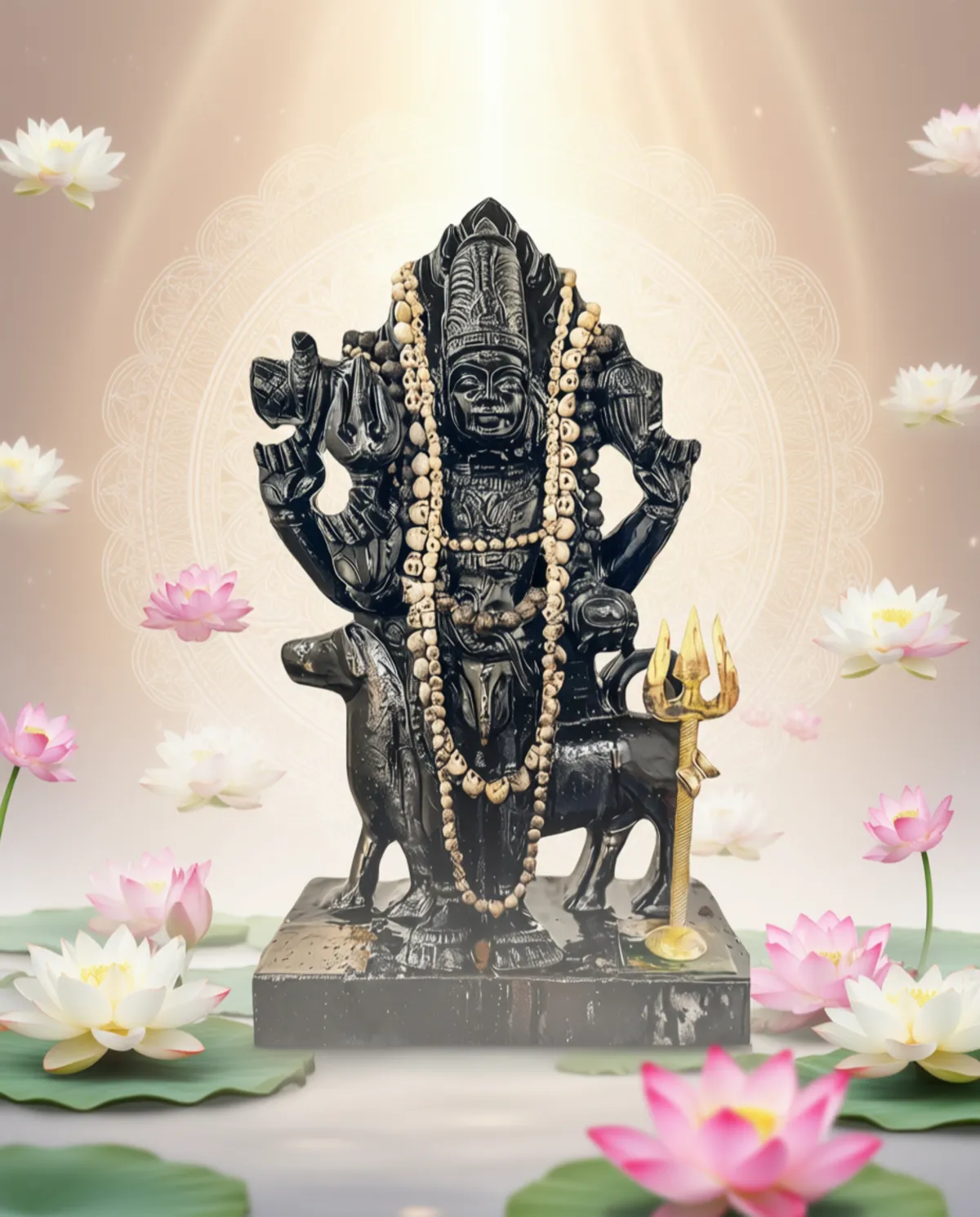
English Recitation Guide
Deva-Raaja-Sevyamaana-Paavana-Angghri-Pangkajam
Vyaala-Yajnya-Suutram-Indu-Shekharam Krpaakaram |
Naarada-[A]adi-Yogi-Vrnda-Vanditam Digambaram
Kaashikaa-Pura-Adhinaatha-Kaalabhairavam Bhaje ||1||
Bhaanu-Kotti-Bhaasvaram Bhavaabdhi-Taarakam Param
Niila-Kannttham-Iipsita-Artha-Daayakam Trilocanam |
Kaala-Kaalam-Ambuja-Akssam-Akssa-Shuulam-Akssaram
Kaashikaa-Pura-Adhinaatha-Kaalabhairavam Bhaje ||2||
Shuula-Ttangka-Paasha-Danndda-Paannim-Aadi-Kaarannam
Shyaama-Kaayam-Aadi-Devam-Akssaram Nir-Aamayam |
Bhiimavikramam Prabhum Vicitra-Taannddava-Priyam
Kaashikaa-Pura-Adhinaatha-Kaalabhairavam Bhaje ||3||
Bhukti-Mukti-Daayakam Prashasta-Caaru-Vigraham
Bhakta-Vatsalam Sthitam Samasta-Loka-Vigraham |
Vi-Nikvannan-Manojnya-Hema-Kingkinnii-Lasat-Kattim
Kaashikaa-Pura-Adhinaatha-Kaalabhairavam Bhaje ||4||
Dharma-Setu-Paalakam Tu-Adharma-Maarga-Naashakam
Karma-Paasha-Mocakam Su-Sharma-Daayakam Vibhum |
Svarnna-Varnna-Shessa-Paasha-Shobhitaangga-Mannddalam
Kaashikaa-Pura-Adhinaatha-Kaalabhairavam Bhaje ||5||
Ratna-Paadukaa-Prabhaabhi-Raama-Paada-Yugmakam
Nityam-Advitiiyam-Isstta-Daivatam Niramjanam |
Mrtyu-Darpa-Naashanam Karaala-Damssttra-Mokssannam
Kaashikaa-Pura-Adhinaatha-Kaalabhairavam Bhaje ||6||
Atttta-Haasa-Bhinna-Padmaja-Anndda-Kosha-Samtatim
Drsstti-Paata-Nasstta-Paapa-Jaalam-Ugra-Shaasanam |
Asstta-Siddhi-Daayakam Kapaala-Maalikaa-Dharam
Kaashikaa-Pura-Adhinaatha-Kaalabhairavam Bhaje ||7||
Bhuuta-Samgha-Naayakam Vishaala-Kiirti-Daayakam
Kaashi-Vaasa-Loka-Punnya-Paapa-Shodhakam Vibhum |
Niiti-Maarga-Kovidam Puraatanam Jagatpatim
Kaashikaapuraadhinaathakaalabhairavam Bhaje ||8||
Kaalabhairavaassttakam Patthamti Ye Manoharam
Jnyaana-Mukti-Saadhanam Vicitra-Punnya-Vardhanam |
Shoka-Moha-Dainya-Lobha-Kopa-Taapa-Naashanam
Prayaanti Kaalabhairava-Amghri-Sannidhim Naraa Dhruvam ||9||
Kalabhairava Ashtakam, traditionally attributed to Adi Shankaracharya, is one of those hymns that becomes deeper the longer you sit with it. On the surface it praises a fierce form of Shiva. Beneath that, it is a meditation on time, death, detachment, justice, and liberation.
What makes the stotram powerful is its central paradox: Kalabhairava looks terrifying, yet everything in the hymn points toward grace. He is the one who strips away fear by forcing us to face what we spend most of our lives avoiding.
This commentary stays with that spirit. I will walk through the verses one by one, give a plain English translation, and then share the deeper symbolism as I understand it.
Introduction to Kalabhairava Baba
Before entering the verses, it helps to be clear about who Kalabhairava is.
Kala means time, and by extension death. Bhairava means the awe-inspiring, fearsome one. Put together, the name points to the form of Shiva who rules over time, stands beyond time, and breaks the fear that time creates in us.
That fearsome form should not be read as cruelty. Whether in old paintings or modern AI renderings, the outer image can shock the mind. But the tradition does not treat Kalabhairava as malevolent. For the bhakta, his fierceness is protective. It cuts ego, pride, delusion, and hesitation.
To me, Kalabhairava Baba is the Guru tattva of Shiva in an especially sharp form. He does not flatter. He strips, tests, purifies, and clears the path. In that sense he is not only a kshetrapala; he is also a filter.
That is why Kashi matters so much in this hymn. Kashi is of course a physical city, but in the language of sadhana it also points to a state of liberation, clarity, and inner crossing. Kalabhairava is repeatedly invoked here as the Lord of Kashi because the hymn sees him as the one who governs entry into that state.
He grants vairagya. He hastens the inner samudra manthan of the seeker. When poison rises in that churning, he is the one who helps the devotee endure it and move through it.
He also gives adhara. He steadies the spine of the seeker, inwardly and spiritually, so the path can actually be walked instead of merely admired.
The refrain of the first eight verses is:
Kaashikaa-Pura-Adhinaatha-Kaalabhairavam Bhaje
It means: "I worship Kalabhairava, the Lord of the city of Kashi."
That line keeps returning because the hymn never lets us forget his role. Kalabhairava here is not only being praised as a cosmic deity. He is being remembered as the one who guards the threshold of liberation.
Jai Kalabhairava Baba.
Verse 1
Sanskrit:
Deva-Raaja-Sevyamaana-Paavana-Angghri-Pangkajam
Vyaala-Yajnya-Suutram-Indu-Shekharam Krpaakaram |
Naarada-[A]adi-Yogi-Vrnda-Vanditam Digambaram
Kaashikaa-Pura-Adhinaatha-Kaalabhairavam Bhaje ||1||
Translation:
I worship Kalabhairava, the Lord of Kashi, whose sacred lotus feet are served by Indra, king of the devas; who wears a serpent as his sacred thread, bears the crescent moon on his forehead, and is full of compassion; who is praised by Narada and hosts of yogis, and who is Digambara, clothed only by the directions.
Commentary:
The opening verse establishes rank immediately. If Indra himself serves at Kalabhairava's feet, then Bhairava is not a local or minor deity in this hymn. He stands above the normal divine hierarchy.
The symbols in his appearance matter. A snake takes the place of the usual sacred thread. That is not decorative. It shows a power that is beyond social orthodoxy and fully at ease with forces most people fear: death, change, kundalini, time.
The moon on his head links him unmistakably to Shiva and to mastery over time's cycles. But the line does not stop with fierceness. It also calls him Krpaakaram, the source of compassion. That contrast is the key to reading the whole hymn correctly.
Digambara, sky-clad, suggests naked reality. No ornament of status, no covering of convention, no borrowed identity. Just pure being.
Verse 2
Sanskrit:
Bhaanu-Kotti-Bhaasvaram Bhavaabdhi-Taarakam Param
Niila-Kannttham-Iipsita-Artha-Daayakam Trilocanam |
Kaala-Kaalam-Ambuja-Akssam-Akssa-Shuulam-Akssaram
Kaashikaa-Pura-Adhinaatha-Kaalabhairavam Bhaje ||2||
Translation:
I worship Kalabhairava, the Lord of Kashi, who shines like millions of suns, who carries beings across the ocean of worldly existence, who has the blue throat, grants cherished aims, and has three eyes; who is the death of death itself, whose eyes are lotus-like, whose weapon is the trident, and who is imperishable.
Commentary:
This verse refuses the lazy idea that a deity associated with death must belong to darkness alone. Kalabhairava here blazes like countless suns. The light is not merely physical brightness; it is the light of consciousness that burns through ignorance.
He is also called Bhavaabdhi-Taarakam, the one who ferries us across samsara. That makes his fierceness easier to understand. He is not terror for its own sake. He is the force that gets the seeker across.
The blue throat recalls Shiva drinking poison for the sake of creation. So the hymn links Bhairava not only with destruction, but with containment. He can absorb what would otherwise overwhelm the world or the seeker.
Kaala-Kaalam is one of the strongest phrases in the stotram. He is the death of death, the time of time. In other words, even the thing that devours all beings is itself subordinate to him.
Verse 3
Sanskrit:
Shuula-Ttangka-Paasha-Danndda-Paannim-Aadi-Kaarannam
Shyaama-Kaayam-Aadi-Devam-Akssaram Nir-Aamayam |
Bhiimavikramam Prabhum Vicitra-Taannddava-Priyam
Kaashikaa-Pura-Adhinaatha-Kaalabhairavam Bhaje ||3||
Translation:
I worship Kalabhairava, the Lord of Kashi, who holds the trident, axe, noose, and staff in his hands; who is the primal cause, dark-bodied, the first among the gods, imperishable, and free from decay; who is immensely powerful and delights in the wondrous Tandava dance.
Commentary:
The weapons here should not be reduced to a violent image. In traditional symbolism, each one carries a function. The trident breaks the threefold knots of suffering. The noose binds and pulls in what must be dealt with. The staff signals authority, law, and consequence.
The verse also calls him Aadi-Kaarannam, the primal cause. That lifts him beyond the level of a deity acting inside creation. He is being praised as a source behind creation itself.
His dark body points toward the unmanifest. Before forms emerge, there is the depth from which they arise. Bhairava's darkness here is not absence. It is density, mystery, and potential.
His love for the Tandava matters too. The cosmic dance is not only destruction. It is the rhythm of creation, preservation, and dissolution together. Bhairava does not merely endure that rhythm; he revels in it.
Verse 4
Sanskrit:
Bhukti-Mukti-Daayakam Prashasta-Caaru-Vigraham
Bhakta-Vatsalam Sthitam Samasta-Loka-Vigraham |
Vi-Nikvannan-Manojnya-Hema-Kingkinnii-Lasat-Kattim
Kaashikaa-Pura-Adhinaatha-Kaalabhairavam Bhaje ||4||
Translation:
I worship Kalabhairava, the Lord of Kashi, who grants both worldly fulfillment and liberation, whose form is beautiful and worthy of praise, who is deeply affectionate toward devotees, who abides as the form of all worlds, and whose waist is adorned with golden bells that ring sweetly.
Commentary:
This verse softens the image without weakening it. Kalabhairava is not presented as a deity who rejects the world outright. He grants both bhukti and mukti. That means he governs the full arc of life, not only its ending.
Bhakta-Vatsala is especially important. The frightful one is also tender toward his devotees. That repeated reversal is one of the hymn's most beautiful features.
Then comes a striking sensory detail: the golden bells at his waist. The image is not abstract philosophy anymore. You can almost hear him moving. That small sound changes the emotional texture of the verse. Terror gives way to intimacy.
Verse 5
Sanskrit:
Dharma-Setu-Paalakam Tu-Adharma-Maarga-Naashakam
Karma-Paasha-Mocakam Su-Sharma-Daayakam Vibhum |
Svarnna-Varnna-Shessa-Paasha-Shobhitaangga-Mannddalam
Kaashikaa-Pura-Adhinaatha-Kaalabhairavam Bhaje ||5||
Translation:
I worship Kalabhairava, the Lord of Kashi, who protects the bridge of Dharma and destroys the path of Adharma, who frees beings from the bonds of karma and bestows peace and welfare, and whose body is adorned by a radiant golden serpent.
Commentary:
Here the hymn shows Kalabhairava as guardian of order. He is not merely a fierce ascetic roaming cremation grounds. He is the keeper of Dharma.
That also explains why he is terrifying. His fierceness is directed toward falsehood, imbalance, and the path that deepens bondage. He is severe where severity is needed.
Karma-Paasha-Mocakam is one of the most comforting phrases in the stotram. The same deity who judges also releases. Bhairava is not just an enforcer of cosmic law; he is the one who can untie what karma has knotted.
The golden serpent continues a theme that runs through the hymn. What frightens ordinary perception becomes an ornament in him. Time, fear, death, power, and law are all worn openly because he is beyond being threatened by them.
Verse 6
Sanskrit:
Ratna-Paadukaa-Prabhaabhi-Raama-Paada-Yugmakam
Nityam-Advitiiyam-Isstta-Daivatam Niramjanam |
Mrtyu-Darpa-Naashanam Karaala-Damssttra-Mokssannam
Kaashikaa-Pura-Adhinaatha-Kaalabhairavam Bhaje ||6||
Translation:
I worship Kalabhairava, the Lord of Kashi, whose pair of feet shines with the radiance of gem-studded sandals, who is eternal, without a second, the chosen deity, and stainless; who destroys the pride of death and grants liberation through his terrible fangs.
Commentary:
This verse moves openly into non-dual language. Advitiiyam means without a second. Adi Shankaracharya's philosophical current is easy to hear here. The deity being worshipped is not separate from absolute reality.
Mrtyu-Darpa-Naashanam goes beyond saying that Bhairava defeats death. It says he breaks death's pride. Death itself loses its swagger before him.
The last phrase is one of the sharpest in the whole hymn: liberation through terrifying fangs. The point is not theatrical horror. The point is that what frightens the ego may be precisely what frees the soul.
This is why Bhairava devotion is not sentimental. It asks for courage. It asks the seeker to stop bargaining with fear and pass through it.
Verse 7
Sanskrit:
Atttta-Haasa-Bhinna-Padmaja-Anndda-Kosha-Samtatim
Drsstti-Paata-Nasstta-Paapa-Jaalam-Ugra-Shaasanam |
Asstta-Siddhi-Daayakam Kapaala-Maalikaa-Dharam
Kaashikaa-Pura-Adhinaatha-Kaalabhairavam Bhaje ||7||
Translation:
I worship Kalabhairava, the Lord of Kashi, whose loud laughter shatters the cosmic shells created by Brahma, whose mere glance destroys the web of sin, who is a fierce ruler, who grants the eight siddhis, and who wears a garland of skulls.
Commentary:
This is one of the grandest verses in the hymn. His laughter alone is enough to rupture cosmic structure. That image is not subtle, and it is not meant to be. The verse is declaring supremacy without qualification.
Then it turns inward. A single glance from him destroys the web of accumulated wrongdoing. The movement is important: cosmic force, then personal purification.
The skull-garland is a familiar Bhairava image, but it should be read carefully. It is not morbidity for its own sake. It reminds us that every identity, every body, every era has an ending. Bhairava wears that truth openly because he is beyond what passes away.
Verse 8
Sanskrit:
Bhuuta-Samgha-Naayakam Vishaala-Kiirti-Daayakam
Kaashi-Vaasa-Loka-Punnya-Paapa-Shodhakam Vibhum |
Niiti-Maarga-Kovidam Puraatanam Jagatpatim
Kaashikaapuraadhinaathakaalabhairavam Bhaje ||8||
Translation:
I worship Kalabhairava, the Lord of Kashi, who leads the hosts of spirits, bestows great renown, purifies the merits and sins of those dwelling in Kashi, knows the path of righteousness, is ancient, and is the Lord of the universe.
Commentary:
As lord of spirits and unseen beings, Bhairava stands at the edge between visible and invisible worlds. That liminal quality is central to his nature. He rules thresholds.
This verse also brings the hymn back to Kashi in a very direct way. He is the one who purifies both punya and papa there. That is a subtle line. Liberation is not reached simply by collecting merit. Even merit must eventually be exhausted or transcended.
The final words, Puraatanam Jagatpatim, return him to timelessness. He is ancient not merely in the sense of old, but in the sense of prior. He is already there before our categories begin.
Verse 9 (The Phala Shruti - Verse of Benefits)
Sanskrit:
Kaalabhairavaassttakam Patthamti Ye Manoharam
Jnyaana-Mukti-Saadhanam Vicitra-Punnya-Vardhanam |
Shoka-Moha-Dainya-Lobha-Kopa-Taapa-Naashanam
Prayaanti Kaalabhairava-Amghri-Sannidhim Naraa Dhruvam ||9||
Translation:
Those who recite this beautiful Kalabhairava Ashtakam, which is a means to knowledge and liberation, which increases merit, and which destroys grief, delusion, poverty, greed, anger, and suffering, will surely attain the presence of Kalabhairava's feet.
Commentary:
The final verse explains what the hymn itself is for. It is not only praise. It is sadhana.
The list of what it destroys is telling: sorrow, delusion, helplessness, greed, anger, affliction. These are not distant philosophical abstractions. They are the everyday knots that keep a person restless and bound.
The verse ends on the word Dhruvam - certainly, surely, without doubt. That certainty matters. A hymn like this is meant to steady the practitioner, not merely impress the intellect.
Thus concludes the Kalabhairava Ashtakam.
I should also say plainly that much of what I have shared here is not "mine" in any possessive sense. It comes from listening, reading, reflecting, and receiving. I remain grateful to Bhairava for sending Praveen anna into this life and for the force of jnana that broke through when it was needed.
Om Shri Gurubhyo Namah. Jai Khyapa Parampara.
If you find mistakes in this article, please read it with that spirit. I am a seeker, not a Sanskrit scholar. I have tried to make this hymn easier to approach for those who feel drawn toward Ma Kali and Kalabhairava Baba. The outcome belongs to them.
If you made it this far, perhaps the hymn was meant to meet you. Jnana reaches whom it reaches. There is no value in gatekeeping what was received through grace. We all stand on the shoulders of those who came before us.
Jai Ma Adya Mahakali. Jai Kalabhairava. Jai Ma Krishna.
Spiritual Insight
Kalabhairava Ashtakam is a hymn on time, fear, detachment, and liberation. Read slowly, it becomes not just praise, but a way of seeing what Bhairava removes and what he protects.