Om Shri GuruBhyo Namah. Jai Khyapa Parampara.
Thank you Ma Adya for permitting me to post this. You sent me here again with amnesia. Please forgive any mistakes ever made, will be made (you are trikaldarshi nothing is hidden from you) and unlock thy potential to sing your glory again with the tools of this age.
Prayer from your eternal dasa, sevak and putra Ashish.
Jai Ma Adya Mahakali, Jai Ma Krishna, Jai Kalabhairava
Dive into this simple Ma Kali stotram to understand her nature, imagery so you can go closer into the black mass that is MA Kali. A complete guide with English lyrics, verse-by-verse translations, and a deep look.
Introduction to the Shri Kali Tandava Stotram
The term Tāṇḍava refers to a vigorous, divine dance, associated with Lord Shiva in Nataraja form. It is a dance of cycles of creation, preservation, and dissolution. This stotram (hymn of praise) describes the awe-inspiring and fierce Tāṇḍava of Ma Kāli, the primordial Shakti (energy).
Ma Kāli's form, as described in this hymn, is terrifying to the ego-mind lost in karma yoga and maya; but liberating for the soul (jivah, atman). Ma embodies untamed reality, raw power, time, and change. Her dance is the what powers all beings animate and inanimate in the infinite multiverse.
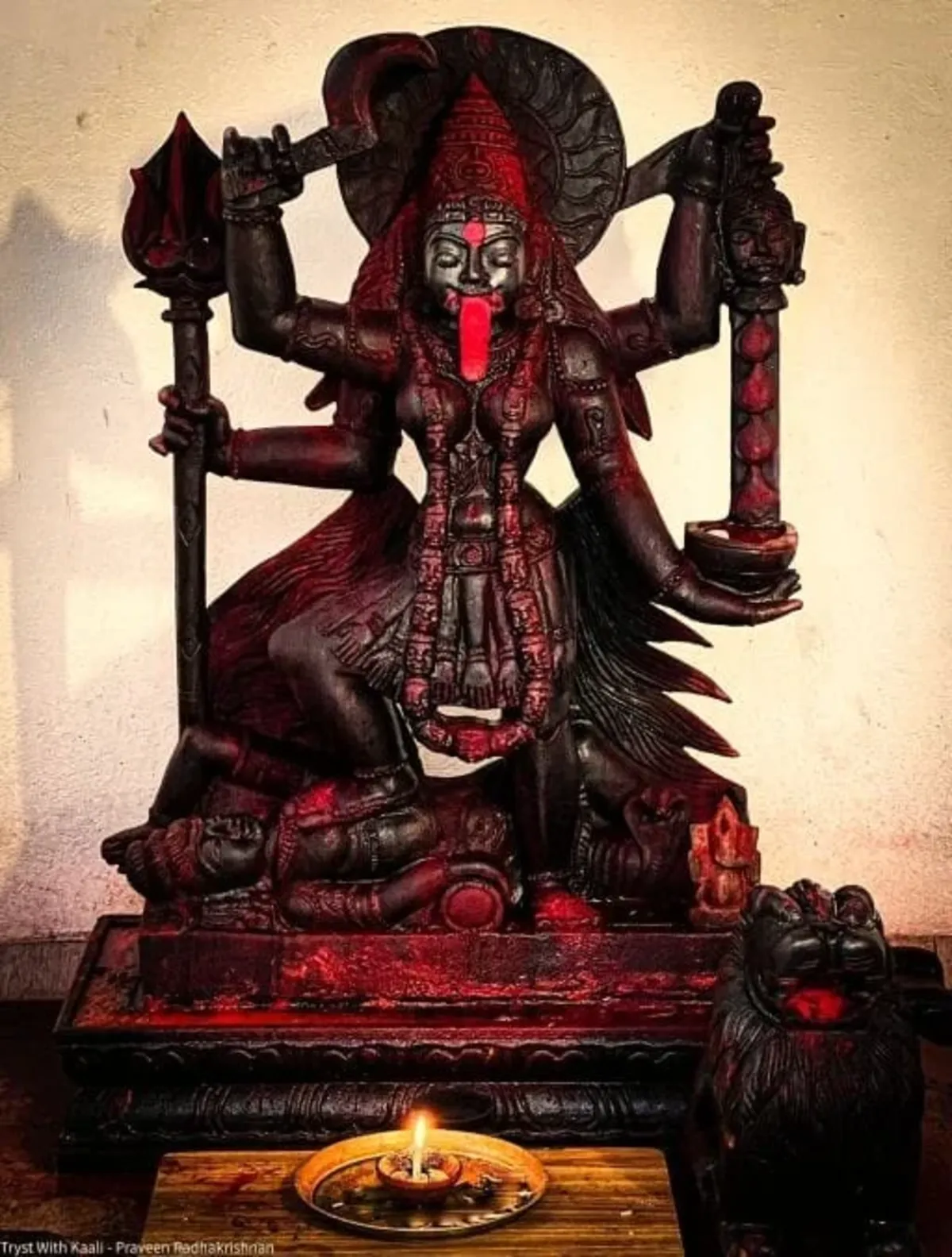 Ma Kali in her fierce Tandava form - The Divine Mother as the all-consuming power of Transformation.
This stotram encompasses her most formidable and compassionate aspects, seeing the "Divine Mother" even within the most terrifying imagery. Ma Kali's pictures made eons ago, projected in artists' minds by her, are meant to shock and terrify until she flips the switch and opens the jnana for her bhaktas. The new images being made now by AI are also her; latent space is pure math and a black box system.
English Recitation Guide
huṃhuṃkāre śavārūḍhe nīlanīrajalocane ।
trailokyaikamukhe divye kālikāyai namo'stute ॥1॥
pratyālīḍhapade ghore muṇḍamālāpralambite ।
kharve lambodare bhīme kālikāyai namo'stute ॥2॥
navayauvanasampanne gajakumbhopamastanī ।
vāgīśvarī śive śānte kālikāyai namo'stute ॥3॥
lolajihve durārohe netratrayavibhūṣite ।
ghorahāsyatkare devī kālikāyai namo'stute ॥4॥
vyāghracarmmāmbaradhare khaḍgakarttṛkare dhare ।
kapālendīvare vāme kālikāyai namo'stute ॥5॥
nīlotpalajaṭābhāre sindurendumukhodare ।
sphuradvaktroṣṭadaśane kālikāyai namo'stute ॥6॥
pralayānaladhūmrābhe candrasūryāgnilocane ।
śailavāse śubhe mātaḥ kālikāyai namo'stute ॥7॥
brahmaśambhujalaughe ca śavamadhye prasaṃsthite ।
pretakoṭisamāyukte kālikāyai namo'stute ॥8॥
kṛpāmayi hare mātaḥ sarvāśāparipūrite ।
varade bhogade mokṣe kālikāyai namo'stute ॥9॥
ityuttaratantrārgatamaṃ śrīkālītāṇḍavastotraṃ sampūrṇam
Verse 1
huṃhuṃkāre śavārūḍhe nīlanīrajalocane ।
trailokyaikamukhe divye kālikāyai namo'stute ॥1॥
Translation
To Her who resounds with the primordial sound "Huṃ," who is mounted upon a lifeless form (śava), whose eyes are like blue lotuses; to that divine Goddess who is the one single face of the three worlds, to You, Kālikā, I offer my salutations.Commentary
This opening verse establishes her supreme, transcendent nature.huṃhuṃkāre: "Huṃ" is a powerful bīja (seed) mantra, representing fierce divine power, consciousness, and the light of the darkness. Her very being vibrates with this cosmic sound.
śavārūḍhe: She is seated upon a corpse. This iconic imagery signifies that she is the supreme life force (Shakti or dynamic energy) that animates the inert universe (personified by the shava, often identified with Sadashiva, pure consciousness). It also means she is beyond the limitations of the physical body and death itself.
nīlanīrajalocane: Her eyes, like blue lotuses, are not just beautiful but deep, vast, and mysterious, holding the infinity of the cosmos. This contrast highlights her dual nature: she is both the fearsome destroyer and the compassionate, beautiful dark (shyama) Mother.
trailokyaikamukhe: She is the single, ultimate reality behind the three worlds both seen (earth) and unseen (heaven and netherworld). All of creation is just an expression of her divine face.
Verse 2
pratyālīḍhapade ghore muṇḍamālāpralambite ।
kharve lambodare bhīme kālikāyai namo'stute ॥2॥
Translation
To Her who stands in the Pratyālīḍha warrior pose, who is fearsome, and adorned with a long, dangling garland of severed heads; to Her who is short in stature, with a large belly, and who is terrifying to behold, to You, Kālikā, I offer my salutations.Commentary
This verse describes her formidable, warrior form.pratyālīḍhapade: This is a specific martial stance (left foot forward, right knee bent), indicating she is actively engaged in battle with our ignorance and ego. There is no good and evil with Ma Kali as she is mother of all (deva and asura tatva). She guides us not like Ma Krishna but as a battlefield commander who slogs with us in the trenches of eternal Kurukshetra inside everyone.
ghore muṇḍamālāpralambite: She is fearsome (ghore). Her fierceness is not random chaos; it is the focused, divine power that destroys negativity and ignorance for the sake of spiritual freedom. The garland of severed heads (muṇḍamālā) symbolizes the trophies of her favorite devotees propelled to unforeseen levels by her benediction; making them unique among trillions in the entire creation, an honor second only to be two babies adorning her earrings.
kharve lambodare bhīme: "Short in stature" (kharve) can imply a concentrated, dense form of power. Her "large belly" (lambodare), like Ganesha's, signifies that she contains all the universes within her (cosmic garbha). She is terrifying (bhīme) to those attached to their ego, but a mother and liberator for her bhaktas.
Verse 3
navayauvanasampanne gajakumbhopamastanī ।
vāgīśvarī śive śānte kālikāyai namo'stute ॥3॥
Translation
To Her who is endowed with the fullness of eternal youth, whose breasts are full and majestic like the frontal globes of an elephant's head; to the supreme Goddess of Speech, the auspicious and peaceful one, to You, Kālikā, I offer my salutations.Commentary
This verse reveals the benevolent, nurturing aspect hidden within her fierce form.navayauvanasampanne: She is ever-youthful, representing the ceaseless, fresh, and potent creative energy of the cosmos. She is beyond the decay of time and the source of all vitality.
gajakumbhopamastanī: This is a classical poetic metaphor. The elephant's head symbolizes royalty, strength, and abundance. As the Divine Mother, her fullness represents both material and spiritual nourishment for all of creation.
vāgīśvarī śive śānte: In stark contrast to her terrifying appearance, she is the ultimate source of knowledge and speech (vāgīśvarī), supremely auspicious (śive), and the embodiment of deep peace (śānte). This highlights the paradox of her nature. She makes her bhaktas alpha predators while keeping them in check with peace and detachment. The benediction of Ma Kali breaks the mirror or curtain of maya and you get to see the code of the matrix like NEO.
Verse 4
lolajihve durārohe netratrayavibhūṣite ।
ghorahāsyatkare devī kālikāyai namo'stute ॥4॥
Translation
To Her with the lolling, restless tongue, who is difficult to approach or comprehend, and who is adorned with three eyes; to the Goddess whose terrifying laughter resounds, to You, Kālikā, I offer my salutations.Commentary
This verse describes her transcendental and world-shaking power.lolajihve: Her extended, blood-red tongue laps up all and ultimately consumes the entire universe during its dissolution. It represents her unrestrained, all-consuming energy.
durārohe: She is difficult to comprehend with the limited intellect. Her true nature is a sacred mystery firewalled by Bhairava. Open to few with immense courage (Veera) not afraid to lose a head or two of their own.
netratrayavibhūṣite: Her three eyes represent the sun, moon, and fire. They signify her ability to see the past, present, and future, transcending time and duality. She sees the jivah/atman calling out to her with the third eye of wisdom (jñāna). Ma Kali is also known as trikaldarshi reinforcing this aspect of her nature. This does not mean you fake things to get her attention; you just have to be true to yourself and wipe the word "afraid" from your psyche. She has made you; the test is to play the cards you are dealt and still fight to move the needle towards moksha.
ghorahāsyatkare: Her fierce laughter shatters all illusions, destroys inner demons (maintain balance of sur and asura with you), and can shake the foundations of the cosmos. It is the sound of absolute freedom.
Verse 5
vyāghracarmmāmbaradhare khaḍgakarttṛkare dhare ।
kapālendīvare vāme kālikāyai namo'stute ॥5॥
Translation
To Her who wears a tiger skin as her garment, who holds a sword and a cleaver in her hands; and who in her left hands holds a skull-cup and a blue lotus, to You, Kālikā, I offer my salutations.Commentary
This verse details the symbolic items she holds in her four hands and her adornments. This is quite surprising as this form resembles Ma Tara so closely than Ma Kali. My interpretation is, this is a poetic stanza rather than a dhyana mantra helping a bhakta visualize Ma Kali. So without creative freedom we move forward in commentary.The gist of these lines: Ma Kali's four hands hold both destruction of the negative from our lives and the flourishing of spiritual grace.
vyāghracarmmāmbaradhare: The tiger skin signifies her complete mastery over the raw, animalistic forces of nature and desire. It is the seat of a master yogi.
khaḍgakarttṛkare: The sword (khaḍga) cuts through ignorance, doubt, and bondage. The cleaver or scythe (kartṛ) or scissors severs attachments to the world(maya) and the ego.
kapālendīvare vāme: The skull-cup (kapāla) represents her complete detachment from the body and mind. The blue lotus (indīvara) symbolizes spiritual beauty, purity, and the promise of divine grace, even amidst destruction. Lotus imagery shows jnana and decentralized nature of knowledge. It can come from unsuspecting unclean muck just like a lotus. That's why it's advised to respect and not judge anyone. Jnana doesn't see caste color or creed and a true seeker should absorb like a sponge till a physical or mansik guru comes along and they both resonate with the same frequency. Both forming a symbiote and walking towards liberation.
Verse 6
nīlotpalajaṭābhāre sindurendumukhodare ।
sphuradvaktroṣṭadaśane kālikāyai namo'stute ॥6॥
Translation
To Her whose mass of matted hair is dark like a blue lotus, whose face shines with sindoor and the moon; whose face, lips, and teeth are radiant and vibrant, to You, Kālikā, I offer my salutations.Commentary
A detailed and intimate description of her divine face.nīlotpalajaṭābhāre: Her matted locks, like those of a renunciant, are untamed and unbound, symbolizing her absolute freedom from all conventions. Their dark blue hue signifies infinity.
sindurendumukhodare: The sindoor (vermillion powder) marks her as the eternal consort of Lord Shiva and active (shakti) principle of life and energy. The moon (indu) on her face symbolizes divine consciousness, coolness, and beauty amidst her ferocity.
sphuradvaktroṣṭadaśane: Her features are not static but pulsating with energy (sphurad), alive and full of divine power, reinforcing her active nature. Her fangs hint at her rakshashi nature; implying she is possessive and cares about her creations (who doesn't want a mother that cares so much about you). She is the birth mother and devourer of all. "Devourer" should not be taken in a negative connotation, as that just signifies giving upliftment. The jivah/atman is eternal; Ma Kali's love language is martial and tough love. That's why she loves the Veeras who are not afraid to lose a head or two in the journey toward liberation with her.
Verse 7
pralayānaladhūmrābhe candrasūryāgnilocane ।
śailavāse śubhe mātaḥ kālikāyai namo'stute ॥7॥
Translation
To Her whose complexion is like the smoke of the great fire of universal dissolution, whose three eyes are the moon, sun, and fire; O auspicious Mother who resides in the mountains, to You, Kālikā, I offer my salutations.Commentary
This verse elevates her to the cosmic level and shows she is the final destination for our jivah/atman. That's why attaining oneness is an ultimate tapasya. Maya makes us forget how long we have been chasing her and only with her benediction is the journey allowed to continue. She is the Guru of Dasa MahaVidyas. Mother of Shaktipeetahs (Sati). Veera Janani and eternal consort of Sadashiva, even helping us perceive the unseen Shiva tatva with her grace. If you search "linga" in her 1000 names/sahasranamavali you will understand this nuance much better.pralayānaladhūmrābhe: She is the power of cosmic dissolution (pralaya). Her color is not just black, but the color of the final smoke when all creation has been consumed by the fire of reality (causal death of universe or heat death or big freeze).
candrasūryāgnilocane: Her three eyes are explicitly named as the moon, sun, and fire: the primary forces of light, life, and transformation in the universe. She perceives and controls all of them.
śailavāse śubhe mātaḥ: Here, the tone shifts. After describing her ultimate cosmic power, the stotra calls her "auspicious Mother" (śubhe mātaḥ), residing in the sacred mountains (Kailasha), a place of deep meditation and divine presence.
Verse 8
brahmaśambhujalaughe ca śavamadhye prasaṃsthite ।
pretakoṭisamāyukte kālikāyai namo'stute ॥8॥
Translation
To Her who, in the great deluge of dissolution where even Brahma and Shambhu (Shiva) dissolve, is found established amidst the corpses; to Her who is accompanied by trillions of spirits, to You, Kālikā, I offer my salutations.Commentary
This is one of the most significant verses, describing her as the ultimate substrate (foundation) of all existence in the multiverse.brahmaśambhujalaughe: At the end of a cosmic cycle, even the gods of creation (Brahma) and dissolution (Shambhu/Shiva) merge back into the great ocean of causality. She is that ultimate source and final destination.
śavamadhye prasaṃsthite: She alone remains, firm and present (prasaṃsthite) in the stillness and void (śavamadhye) that follows total dissolution. She is the witness and reality beyond all cycles.
pretakoṭisamāyukte: The trillions of spirits are her attendants. They are the primal, untamed elemental forces of the universe, and she is their absolute commander. That's why to worship her one needs Bhairava's blessing and constant support of his Guru tatva. As he helps manage this aspect of her worship. When you are ready, Gurus (in physical body) come into your life and act as guide to help your jivah/atman navigate the path of liberation and attain oneness with Ma Kali.
Verse 9
kṛpāmayi hare mātaḥ sarvāśāparipūrite ।
varade bhogade mokṣe kālikāyai namo'stute ॥9॥
Translation
O Mother who is full of mercy, the remover of all suffering, the one who completely fulfills all hopes and desires; the giver of boons, the bestower of worldly enjoyments, and the granter of final liberation (Moksha), to You, Kālikā, I offer my salutations.Commentary
The final verse is my favorite. It is a beautiful summation of her role as the compassionate Mother. After witnessing her terrifying and supreme cosmic forms, we now turn to her with complete surrender and love. Invoking her as Ma or mother hastens the entry of shakti tatva in one's life; the only pre-requisite being completion of Karma yoga (of the mortal shell) and satisfaction of Bhairava about your intentions. That's why Bhairava is the ultimate Guru and kshetrapala (firewall) for shakti vidya.kṛpāmayi hare mātaḥ: A direct and loving appeal. She is overflowing with grace (kṛpāmayi) and she takes away (hare) our pain (physical, emotional, spiritual).
sarvāśāparipūrite: She fulfills all desires, whether material or spiritual.
varade bhogade mokṣe: This encapsulates the entirety of human aspiration. She can grant boons (varade), allow for enjoyment of the world (bhogade), and, most importantly, grant the ultimate goal of life: freedom from the cycle of birth and death (moksha).
The fearsome destroyer is also the ultimate giver of grace.
Conclusion
ityuttaratantrārgatamaṃ śrīkālītāṇḍavastotraṃ sampūrṇamThus concludes the Shri Kali Tandava Stotram, which is part of the Uttara Tantra.
To conclude this commentary, I want to acknowledge that a lot of these teachings are not my own; they are accumulated from reading and listening to others. I thank Bhairava for sending Praveen anna in my present life and I am eternally grateful to him for dropping the JDAM (phat) of jnana that broke through and reached my jivah/atman.
Om Shri Gurubhyo Namah. Jai Khyapa Parampara.
If you find mistakes in this article, please understand I am a seeker and not a Sanskrit scholar. I have tried my best to make this easy to understand for all who seek Ma Kali. I have surrendered the outcome to her. Rest she will take care. I will keep writing when adesh comes. You will find most of my long form content on this website, shortform content i post on instagram as posts and reels.
If you got this far. Kudos you are meant to read this. Jnana finds its way to those meant to get it. This is the rule of Prakriti. Especially for those in bhairava path (shakti vidya). We all stand on the shoulder of giants, there is no point in gate keeping. We can only become better by teaching and helping each other.
Jai Ma Adya Mahakali. Jai Kalabhairava. Jai Ma Krishna
Spiritual Insight
Dive into this simple Ma Kali stotram to understand her nature, imagery so you can go closer into the black mass that is MA Kali. A complete guide with English lyrics, verse-by-verse translations, and a deep look.